
Why High-Dimensional Vectors Become Nearly Orthogonal
A natural question in high-dimensional Euclidean space is: if radial differences are no longer reliable, what geometric quantity is still worth keeping? The usual answer is angle. For normalized high-dimensional vectors, inner products contract toward zero and pairwise angles concentrate near
This does not mean high-dimensional space has "no structure." It means that once norms have concentrated, direction becomes the most stable remaining degree of freedom and the most suitable carrier of representation structure. Many properties of modern embedding spaces are built on this fact.
Core view: for random directions on a high-dimensional sphere, normalized inner products have mean zero and variance that decays like
, so angles concentrate near right angles. High-dimensional spaces can therefore hold many weakly correlated directions at once, which provides the geometric basis for embedding separability, spherical-code capacity, and global spreading in contrastive learning [1-4].
1. Starting from inner products: why does normalization drive orthogonality?
Let
Under standard assumptions,
is a sum of
If we further define
and treat
and in high dimension
So as dimension grows, typical random directions do not become parallel. They become increasingly close to orthogonal.
2. Why is this a spherical-geometric law rather than a coincidence?
This is not a quirky feature of the Gaussian model. It is a general consequence of high-dimensional spherical measure. Fix one reference vector at the north pole. A second random point will have its latitude concentrated near the equator. In other words, most of the sphere's surface area lies near directions that are almost orthogonal to any given direction [2][3].
The key feature of a high-dimensional sphere is therefore not that the radius is large, but that the direction measure is redistributed:
- a tiny cap around any given direction has very small area;
- a thick belt of approximately orthogonal directions carries most of the mass;
- sampling two almost parallel random directions is actually unlikely.
This directly continues the logic of the previous article. High-dimensional samples are first compressed radially onto a shell, then angularly toward right angles. The former weakens length information; the latter makes direction structure stand out. Figure 1 visualizes that shift from length to direction.
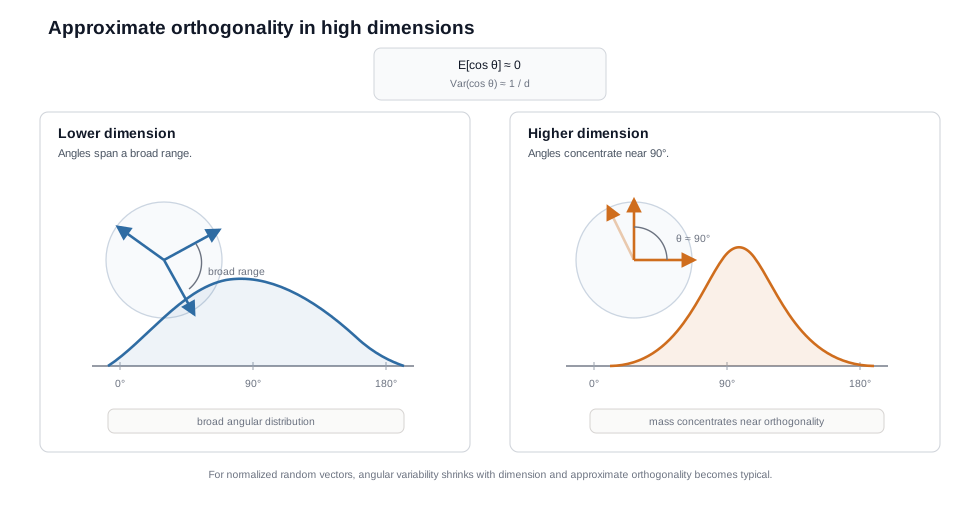
Figure 1. In low dimensions, the angle distribution is broad. In high dimensions, normalized inner products gather near zero and random angles contract around right angles.
The point is not that
3. Why does near-orthogonality imply large capacity?
Once most random directions are naturally weakly correlated, one can place many points on the same sphere without making them strongly interfere. This is the source of directional capacity and the reason spherical coding theory becomes relevant to representation learning [2][3].
If the maximum mutual correlation of unit vectors
then "near-orthogonal" does not require
For representation learning, this has at least three consequences.
- It provides global separability. Many weakly related objects can share one space without immediate collapse.
- It preserves local plasticity. Similar objects can still form local clusters inside small directional regions.
- It supports linear readout. As long as inner products remain meaningful, attention, retrieval, and linear classifiers can all operate stably.
4. Why do embeddings rely so much on directional capacity?
Modern embedding tables often need to hold tens of thousands or even hundreds of thousands of discrete symbols. Low-dimensional intuition suggests that if the number of objects exceeds the number of coordinates, the space must be overcrowded. High-dimensional geometry says otherwise. The real requirement is not "one dimension per token," but "enough directional separation among many tokens."
This capacity is not just a free by-product. It determines whether training can write statistical structure into the space:
- unrelated or weakly related items should stay weakly correlated to avoid large-scale interference;
- related items should still be allowed to cluster locally, so semantic neighborhoods remain useful;
- downstream readout still uses inner products and linear maps, so directional structure must remain computationally accessible.
That is why many normalized representation methods explicitly pull vectors back toward a sphere and encourage global spreading: on a high-capacity directional field, local alignment and global dispersion can be optimized together [4].
5. Near-orthogonality does not mean semantics has already been learned
It is important to separate geometric capacity from semantic organization. High-dimensional near-orthogonality only says the space can hold many directions. It does not say those directions already correspond to task-relevant structure. A randomly initialized embedding matrix may also be nearly orthogonal without carrying any meaning.
Meaning enters through learning:
- the data distribution decides which objects should share context statistics;
- the loss determines which directions should be pulled together and which should be pushed apart;
- the model parameterization decides what geometric form these constraints stabilize into.
So the better statement is: near-orthogonality provides capacity and a low-interference background; semantics still comes from training.
6. Why do learned representations not stay perfectly uniform?
There is also a boundary condition here. The fact that random high-dimensional directions become nearly orthogonal does not mean a good representation space should look purely random and uniform. If a learned embedding were completely uniform on the sphere, semantically related objects would not form stable local neighborhoods, and retrieval, clustering, or classification would gain little from it.
Useful representation geometry is usually a structured deviation from the random-sphere background: globally low correlation to avoid interference, but locally enough clustering to support transfer. This is exactly the tension between alignment and uniformity emphasized by Wang and Isola [4]. If there is only uniformity, the space has capacity but little task value. If there is only alignment, the space quickly collapses.
Near-orthogonality is therefore better viewed as the geometric substrate of representation learning rather than its final finished form.
7. From near-orthogonality to hyperspherical representations
Putting these two steps together gives a clear chain of logic. Radial differences are compressed, and after normalization angles concentrate near right angles. So in a high-dimensional representation space, length is often not the main discriminative variable; direction is. Modern embedding systems then further suppress radial freedom through normalization layers, contrastive learning, and angular-margin losses, eventually pushing representations toward an approximately spherical organization.
That is why the hypersphere viewpoint is natural: in many trained representation systems, the sphere is not just a metaphor. It is a better first-order model than raw Euclidean space.
8. Closing
What becomes scarce in high-dimensional space is not distance, but interpretable geometry. Once norm concentration weakens radial information, direction naturally becomes the main variable. Inner products contracting toward zero and angles concentrating near right angles do not mean geometry disappears. They mean geometry becomes more regular.
More compactly: high-dimensional space offers enormous directional capacity through near-orthogonality, and modern representation learning writes semantics into that capacity. When training further suppresses radial freedom, representation spaces naturally move toward a hypersphere.
References
[1] VERSHYNIN R. High-Dimensional Probability: An Introduction with Applications in Data Science[M]. Cambridge: Cambridge University Press, 2018. DOI: 10.1017/9781108231596.
[2] CAI T T, FAN J, JIANG T. Distributions of Angles in Random Packing on Spheres[J]. Journal of Machine Learning Research, 2013, 14(57): 1837-1864. URL: https://jmlr.org/papers/v14/cai13a.html.
[3] CONWAY J H, SLOANE N J A. Sphere Packings, Lattices and Groups[M]. 3rd ed. New York: Springer, 1999. DOI: 10.1007/978-1-4757-6568-7.
[4] WANG T, ISOLA P. Understanding Contrastive Representation Learning through Alignment and Uniformity on the Hypersphere[C]// Proceedings of the 37th International Conference on Machine Learning. PMLR, 2020: 9929-9939. URL: https://proceedings.mlr.press/v119/wang20k.html.