
Distance Concentration and Metric Breakdown in High Dimensions
The first geometric shock that high dimensions bring to machine learning is not that the space becomes richer because it is larger. In a broad class of random models, the opposite happens: Euclidean distances between samples are squeezed into an increasingly narrow band. Distances do not disappear, but their resolution as ranking and discrimination signals systematically degrades [1-5].
More precisely, the issue is not whether a particular pairwise distance can be computed. The issue is whether the whole collection of distances still spans a meaningful hierarchy. Once the relative gap between the nearest and farthest neighbors keeps shrinking, any algorithm that relies on "who is closer" becomes fragile. This is the core meaning of distance concentration or relative-contrast collapse in the high-dimensional literature [1][2].
Core view: under isotropic high-dimensional models, samples first concentrate on a thin shell of radius about
; pairwise distances then concentrate near ; unless the sample size grows exponentially with dimension, the relative gap between nearest and farthest neighbors shrinks with , so Euclidean distance gradually loses discriminative power [1-5].
1. What exactly does it mean for distance to "break"?
Let the query point be
High-dimensional nearest-neighbor theory is not mainly about individual distance values, but about the relative separation between extremes, for instance
When
but rather that the distances are compressed around the same typical scale, so that noise, scale perturbations, or irrelevant coordinates can easily reorder them.
This distinction matters. Machine learning depends much more on whether distance can reliably separate samples than on whether a distance formula can still be evaluated.
2. Step one: norms concentrate on the same thin shell
Start with the simplest Gaussian model. Let
Then
so
The typical radius therefore scales as 1-Lipschitz function and satisfies the standard concentration inequality [3-5]
Hence
Absolute fluctuations remain on a constant scale, while relative fluctuations decay like
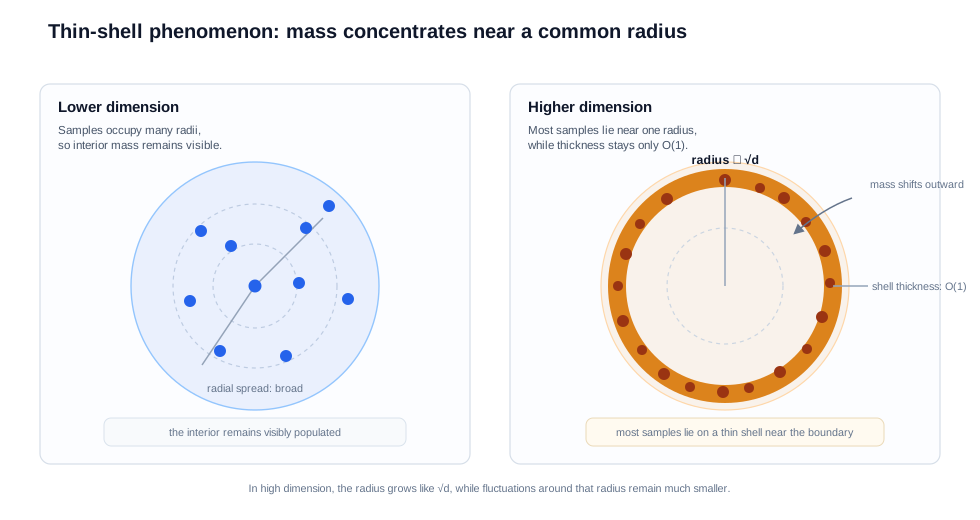
Figure 1. In low dimensions, probability mass is spread across a wider range of radii. In high dimensions, most samples are compressed near a thin shell of radius about
The point of Figure 1 is that radial freedom becomes scarce very quickly in high dimensions. Once that happens, the distribution of pairwise distances can no longer remain as spread out as it is in low dimensions.
3. Step two: pairwise distances also collapse to one scale
If
Therefore
For squared distance, the relative fluctuation is
Using the delta method or an equivalent concentration argument, one gets
This means that high dimension does not broaden the menu of possible pairwise distances. It pushes most of them into a narrow band near
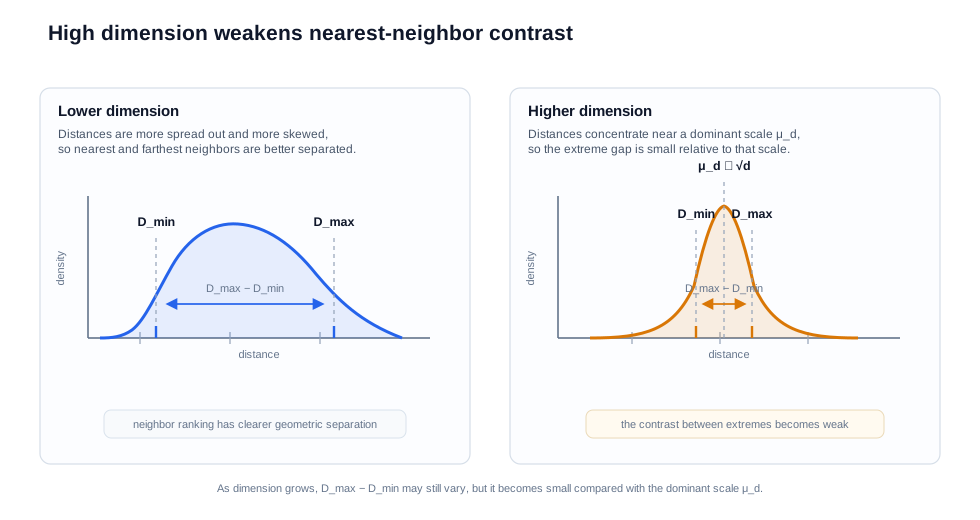
Figure 2. In low dimensions, pairwise distances are spread more broadly. In high dimensions, they contract into a narrower interval, so the separation between nearest and farthest neighbors declines.
The key message is not the mean location, but the width of the distribution. Once the width shrinks enough, extreme-value ranking depends on tiny numerical differences and becomes sensitive to noise.
4. Step three: relative contrast between extremes collapses
Once individual distances already concentrate around a typical scale, the difference between nearest and farthest neighbors can only come from extreme fluctuations, which are usually only a
so
Therefore, unless the sample size
The failure mode is worth stating carefully. High dimensions do not mainly fail because the nearest neighbor is "too far." They fail because all neighbors become almost equally far. The first problem may be repaired by an absolute threshold; the second damages ranking itself.
5. What does this imply for machine learning?
Once distance resolution falls, several classical algorithms are affected directly.
- For
kNN, neighbor ranking becomes unstable. Irrelevant coordinates, scale mismatch, or mild noise can change the nearest-neighbor set. - For clustering, the gap between within-cluster and between-cluster distances shrinks, so methods built on spherical Euclidean assumptions fit sampling noise more easily.
- For vector retrieval, raw Euclidean search on unlearned features is often brittle. Effective systems usually learn a representation first and then choose a metric that matches that representation's geometry.
The most common misreading here is that geometric methods have therefore failed. A better statement is that, without structural assumptions, raw Euclidean distance is usually a poor proxy for semantic similarity. If data lie on a low-dimensional manifold, or if the features have already been normalized, reduced, or metric-learned, distance can become useful again.
6. Is this problem unique to Euclidean distance?
A natural reaction is: if Euclidean distance degenerates, can we fix the problem by switching to another norm? Usually not. Aggarwal et al. showed that different
Metric choice still matters, but it mostly changes the rate of degeneration and the finite-sample behavior. It does not magically erase the curse of dimensionality. That is why the most effective practical improvements are usually not "replace Euclidean with another raw distance" but rather:
- normalize, whiten, or reduce features first to suppress irrelevant dimensions;
- then read the representation with cosine, Mahalanobis, or a learned metric;
- or go further and learn a representation space whose geometry already matches the task.
The real dividing line is not which formula you plug into a distance function. It is whether the current metric matches the true structure of the data.
7. Why must the next step turn to angle and representation learning?
Once thin-shell concentration suppresses radial differences, the remaining degrees of freedom live mainly in direction. That is why modern high-dimensional representation learning rarely treats distance from the origin as its main signal. It focuses instead on normalized angular relations, local subspaces, and low-correlation direction systems shaped by training.
This does not mean geometry stops mattering. It means the raw coordinate geometry is usually not the geometry the task actually needs. Representation learning exists precisely to build a space in which "near" and "far" regain stable statistical meaning.
8. Closing
The most counterintuitive fact about high-dimensional spaces is not that points become far apart, but that most distances become nearly the same. Thin-shell concentration compresses norms first, distance concentration compresses pairwise scales next, and the relative gap between nearest and farthest neighbors is eventually pulled toward zero as well.
The right conclusion is not that Euclidean distance can never be used again. It is that an unlearned high-dimensional Euclidean space is usually not enough to carry semantic similarity directly. Once radius and distance both start to degenerate, the problem naturally shifts toward directional structure.
References
[1] BEYER K S, GOLDSTEIN J, RAMAKRISHNAN R, et al. When Is "Nearest Neighbor" Meaningful?[C]//BEERI C, BUNEMAN P, eds. Database Theory - ICDT'99. Berlin, Heidelberg: Springer, 1999: 217-235. DOI: 10.1007/3-540-49257-7_15.
[2] AGGARWAL C C, HINNEBURG A, KEIM D A. On the Surprising Behavior of Distance Metrics in High Dimensional Space[C]//VAN DEN BUSSCHE J, VIANU V, eds. Database Theory - ICDT 2001. Berlin, Heidelberg: Springer, 2001: 420-434. DOI: 10.1007/3-540-44503-X_27.
[3] LEDOUX M. The Concentration of Measure Phenomenon[M]. Providence, RI: American Mathematical Society, 2001. DOI: 10.1090/surv/089.
[4] VERSHYNIN R. High-Dimensional Probability: An Introduction with Applications in Data Science[M]. Cambridge: Cambridge University Press, 2018. DOI: 10.1017/9781108231596.
[5] BOUCHERON S, LUGOSI G, MASSART P. Concentration Inequalities: A Nonasymptotic Theory of Independence[M]. Oxford: Oxford University Press, 2013. DOI: 10.1093/acprof:oso/9780199535255.001.0001.